Soldering is one of the most important processes in electronics manufacturing, PCB assembly, repair and maintenance. From joining small electronic components to repairing populated circuit boards, the quality of a soldering process can directly affect the performance and reliability of the final product.
As electronic assemblies become smaller and more complex, using the right soldering equipment for electronics has become increasingly important. A basic soldering iron may be enough for occasional repair work, but production environments, PCB assembly lines and professional repair facilities often require temperature-controlled soldering stations, desoldering systems, rework stations, selective soldering machines and supporting accessories.
The right equipment helps technicians and manufacturers maintain controlled temperature, improve solder joint consistency and reduce the chances of component or PCB damage. Sumitron’s product range covers several categories within soldering and desoldering systems, including soldering stations, soldering irons, rework stations, desoldering equipment, soldering accessories and automatic soldering equipment.
What Is Soldering Equipment for Electronics?
Soldering equipment for electronics refers to the tools, systems and machines used to create, remove, repair or control soldered connections in electronic assemblies. These connections are commonly found on printed circuit boards (PCBs), wires, connectors, terminals and electronic components.
Depending on the application, soldering equipment can provide controlled heating, hot air, solder feeding, desoldering, component removal or programmable solder application. The equipment may range from handheld soldering irons for basic repair work to advanced automated systems used in electronics manufacturing.
A professional electronics workstation may use several types of equipment together. For example, a technician may use a soldering station for component installation, a desoldering system for component removal and a hot-air rework station for SMD components.
Why Is Soldering Important in Electronics Manufacturing?
Soldering creates both an electrical and mechanical connection between components and conductive surfaces. A properly formed solder joint provides a reliable path for current while securely holding the component in place.
In electronics manufacturing, consistency is particularly important because a large number of solder joints may be created during PCB assembly. Problems such as cold joints, solder bridges, insufficient wetting or excessive heating can affect the reliability of the finished assembly.
The equipment used during soldering therefore plays an important role in maintaining controlled heat and repeatable working conditions. Temperature-controlled soldering stations, rework systems and automated soldering machines can help manufacturers select the appropriate process according to their PCB design and production requirements.
Types of Soldering Equipment for Electronics
Different electronics applications require different soldering methods. A small repair workshop may primarily need soldering and desoldering tools, while a manufacturing facility may require a combination of manual stations, rework equipment and automated soldering systems.
The component type, PCB design, production volume and nature of the work should all be considered when selecting equipment. The following are some of the commonly used types of soldering equipment in electronics applications.
Soldering Stations
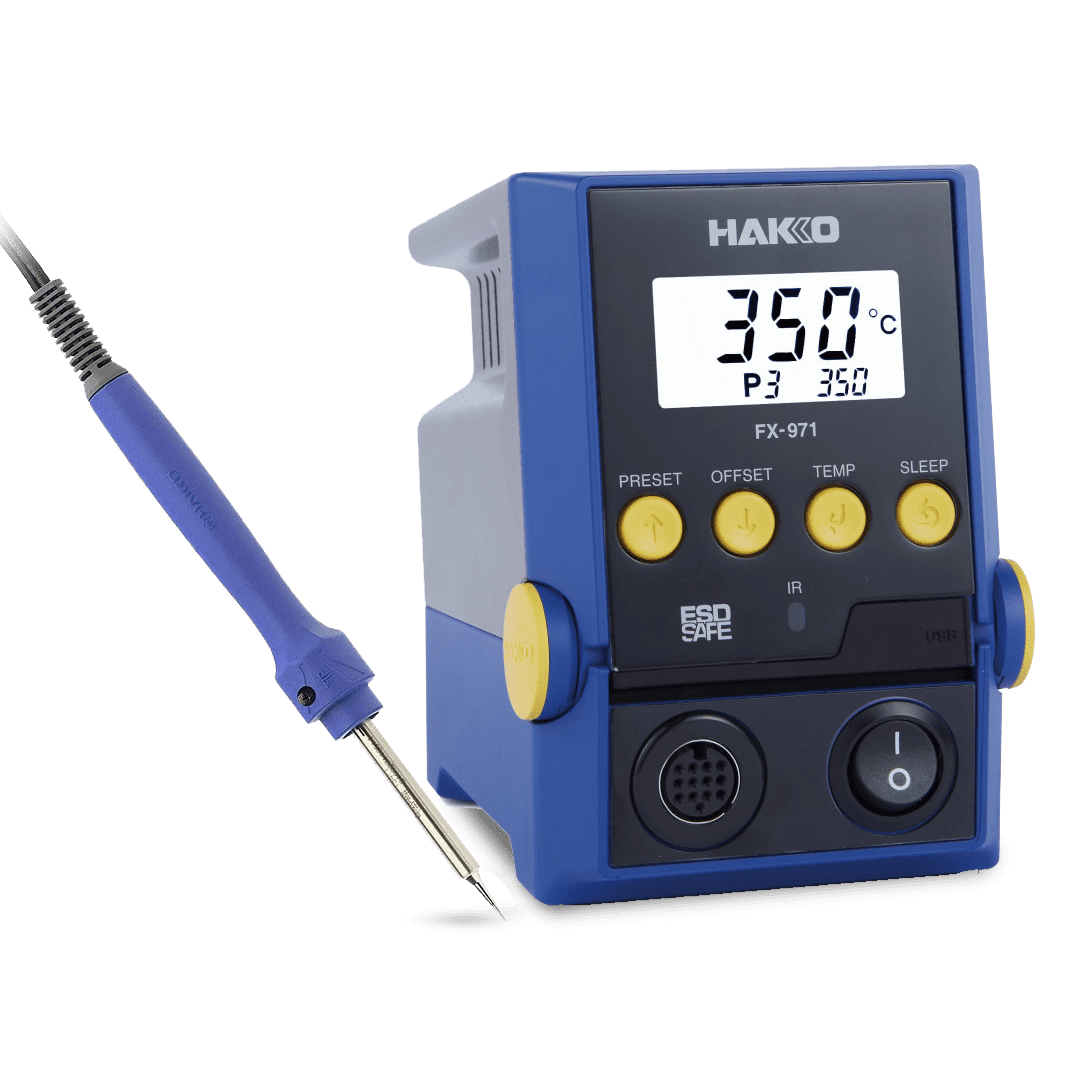
A soldering station is one of the most widely used pieces of equipment for electronic assembly and repair. Unlike a basic soldering iron, a professional station provides controlled heating and allows the operator to use replaceable soldering tips suited to different applications.
Temperature control is one of the most important features of a soldering station because different components and soldering materials may require different working temperatures. Modern stations may also provide rapid thermal recovery, ESD protection and other functions that support consistent work.
Sumitron’s range includes HAKKO soldering stations such as the FX-972, FX-888DX, FX-971, FX-805, FN-1010 and FX-889, along with other models designed for professional electronic and electrical applications.
Soldering Irons
A soldering iron is a handheld tool used to heat solder and create a connection between components, wires or PCB pads. It remains useful for manual assembly, prototyping, repair work and applications where automated equipment is not practical.
Professional soldering irons can be selected according to tip shape, power requirement, temperature range and application. Fine tips may be suitable for smaller components, while larger tips can be used where greater heat transfer is required.
For electronics work, choosing an iron with suitable temperature control is important. Excessive heat can damage components or PCB pads, while insufficient heat may result in poor solder flow and weak joints.
Desoldering Equipment
Desoldering equipment is used when a component, wire or soldered connection needs to be removed from a PCB. It is particularly useful during repair and rework operations where components need to be replaced without unnecessarily damaging surrounding areas.
Professional desoldering systems may use heated tips combined with suction to remove molten solder from through-hole connections. This can make component removal more controlled and efficient than manually applying heat and removing solder separately.
Sumitron’s product range includes dedicated desoldering equipment as well as multi-function rework systems that combine soldering and desoldering capabilities.
Rework Stations
A rework station is designed for PCB repair and component replacement. Depending on the model, it can combine functions such as soldering, desoldering and hot-air rework within a single system.
Rework stations are particularly useful when working with SMD components because hot air can heat the required area and allow components to be removed or installed without relying only on a conventional soldering tip.
For example, the HAKKO FR-702 listed by Sumitron is a four-port rework station combining soldering, desoldering and high-power hot-air functions.
Hot Air Rework Stations
Hot air rework stations are primarily used for SMD component removal and replacement. Instead of transferring heat through a soldering tip, the system delivers controlled hot air to the component and surrounding solder joints.
This makes hot air particularly useful for ICs, connectors and other surface-mount components where access with a conventional soldering iron may be difficult. Operators can adjust temperature and airflow according to the component and PCB requirements.
Sumitron’s HAKKO rework range includes models such as the FR-850 Micro Hot Air SMD Rework, FR-810B and FR-811.
Selective Soldering Equipment
Selective soldering machines are designed to solder specific through-hole connections on a PCB rather than applying solder across the entire board. This can be useful for mixed-technology assemblies containing both SMT and through-hole components.
The process may include controlled flux application, preheating and targeted soldering. Programmable movement allows the machine to follow predetermined soldering paths and apply solder where required.
Sumitron offers selective soldering systems from Tsutsumi, including benchtop and larger automated configurations for applications requiring controlled and repeatable soldering of selected PCB areas.
Key Features to Look for in Soldering Equipment for Electronics
Selecting soldering equipment should involve more than checking its maximum temperature or power rating. The equipment needs to match the application, component type and working environment.
Features such as temperature stability, thermal recovery, ESD protection and compatible tips can directly affect the efficiency and consistency of soldering and rework operations.
Accurate Temperature Control
Temperature control is one of the first specifications to check when selecting soldering equipment. The correct temperature allows solder to melt and flow properly without unnecessarily heating the component or PCB.
A stable system should maintain the selected temperature during continuous operation and recover quickly when the tip comes into contact with a larger thermal load. This becomes particularly important in production environments where operators perform repeated soldering tasks.
For professional electronics manufacturing, temperature stability is generally more useful than simply choosing equipment with the highest possible temperature rating.
ESD-Safe Operation
Electrostatic discharge can damage sensitive electronic components even when there is no visible physical damage. This makes ESD protection an important consideration for soldering equipment used around semiconductor devices and populated PCBs.
An ESD-safe workstation helps reduce the risk of electrostatic discharge reaching sensitive components during assembly, repair or rework. This is particularly relevant for professional electronics manufacturing and repair environments.
Thermal Recovery
Thermal recovery refers to how quickly a soldering system can return to its set temperature after heat is transferred to a component, PCB pad or solder joint.
Good thermal recovery helps maintain consistent soldering performance during repeated work. Without adequate recovery, the soldering tip may lose heat during a joint, potentially affecting solder flow and increasing the time required for the operation.
This feature becomes especially useful in production environments where operators perform many solder joints continuously.
Suitable Tips and Nozzles
The soldering tip or rework nozzle has a direct effect on heat transfer and accessibility. Fine-pitch components may require smaller tips, while larger joints may need a tip with greater thermal capacity.
For hot-air rework, nozzle size and shape should match the component being worked on. Having access to different tips and nozzles gives technicians greater flexibility when handling different PCB designs.
Ease of Operation
Professional equipment should not only provide technical performance but also be practical for everyday use. Clear controls, readable displays and easy temperature adjustment can make repeated soldering tasks more manageable.
For multi-function systems, intuitive operation is even more important because technicians may switch between soldering, desoldering and rework processes throughout the day.
Soldering Equipment for PCB Assembly
PCB assembly can involve several soldering stages depending on the component technology and production method. SMT components are commonly processed through solder paste printing and reflow, while through-hole components may require manual, wave or selective soldering.
Soldering stations remain useful for manual assembly, touch-up and repair. Automated selective soldering can be used when specific through-hole joints need to be processed with greater repeatability.
This combination of manual and automated equipment allows manufacturers to select a soldering method based on the PCB design rather than relying on one process for every assembly.
Soldering Equipment for Electronics Repair and Rework
Repair environments often deal with different PCB designs, component types and failure conditions. A technician may need to remove a damaged component, clean excess solder, install a replacement and inspect the repaired area.
Using separate basic tools for every operation can make the workstation crowded and increase handling time. A multi-function rework station can bring several capabilities into one system.
For example, Sumitron’s HAKKO FM-206 is described as a three-port system that can support soldering, desoldering and rework functions, while the FR-702 provides four-port functionality for soldering, desoldering and hot-air rework.
Soldering Accessories That Support Better Results
The main soldering station is only one part of a professional electronics workstation. Accessories can influence how efficiently and accurately soldering and repair work is performed.
Useful accessories can include tip cleaners, soldering testers, preheaters, vacuum pick-up pens, soldering pots, soldering wire feeders and hot tweezers. The exact accessories required depend on the type of PCB work being carried out.
Sumitron currently lists accessories such as HAKKO SMD hot tweezers, tip cleaners and polishers, preheaters, vacuum pick-up pens, thermometers, soldering pots and soldering wire feeders.
How to Choose the Right Soldering Equipment for Electronics
Choosing the right equipment starts with understanding the work for which it will be used. There is a significant difference between equipment required for occasional PCB repair and equipment required for continuous production.
Considering the application, PCB type, components, temperature requirements and future workload can help businesses select equipment that fits their actual requirements.
Identify the Application First
The first step is to identify whether the equipment will be used for PCB assembly, prototyping, repair, desoldering, SMD rework or production soldering.
For occasional manual soldering, a suitable soldering iron or station may be sufficient. For frequent PCB repair, a rework station can provide greater flexibility, while production lines may require automated soldering equipment.
Consider the Components and PCB Type
Component size and package type should be considered before selecting equipment. Through-hole components, fine-pitch ICs, connectors and larger terminals can all require different soldering approaches.
The PCB material and thickness also influence heat transfer. A system that works well for a small single-sided board may not provide the same performance on a larger multilayer PCB.
Check Temperature and Power Requirements
Power rating should be considered along with temperature range and thermal recovery. Higher power does not automatically mean better performance; the equipment needs to deliver controlled heat appropriate to the application.
For sensitive electronic components, stable temperature control is often more important than maximum temperature. Manufacturers should also check whether the equipment provides the required thermal recovery for their working conditions.
Consider Future Requirements
Soldering equipment is often used for several years, so it is worth considering future PCB designs and applications before making a purchase. A system that supports multiple handpieces, tips or functions can provide greater flexibility as requirements change.
For production environments, factors such as maintenance, spare parts, accessories, operator training and after-sales support should also be included in the evaluation.
Maintenance Tips for Soldering Equipment
Regular maintenance helps keep soldering equipment working consistently and can extend the usable life of equipment and consumables.
Soldering tips should be cleaned correctly and replaced when they become worn or damaged. Temperature performance should also be checked periodically, particularly in production environments where equipment operates for long hours.
Desoldering systems should be kept free from solder blockage, while hot-air systems require appropriate cleaning and inspection. The workstation should also remain organised and ESD-safe, with tips, nozzles and accessories stored properly to reduce unnecessary downtime.
Why Quality Matters When Buying Soldering Equipment
The quality of soldering equipment can have a direct effect on production consistency, repair accuracy and component safety. Equipment with unstable temperature, poor thermal recovery or inconsistent heating can make it more difficult to achieve reliable solder joints.
Professional equipment is designed with controlled heating, replaceable consumables and application-specific features. For manufacturers and repair centres, these characteristics can help reduce avoidable rework and improve day-to-day productivity.
Sumitron has been supplying industrial tools, equipment and materials since 1986 and serves sectors including electronics, electrical, automotive, pharmaceutical and telecom industries. Its portfolio includes soldering and desoldering systems, automatic soldering equipment, SMT process equipment, inspection systems and related electronics manufacturing solutions.
Frequently Asked Questions
Q1. What is soldering equipment used for in electronics?
Ans. Soldering equipment is used to create, repair and remove soldered connections in electronic assemblies. It can be used for PCB assembly, component installation, repair, desoldering and SMD rework.
Q2. What is the most common soldering equipment for electronics?
Ans. Soldering stations are among the most commonly used equipment for electronics assembly and repair. They provide controlled heating and can accommodate different soldering tips for different applications.
Q3. What is the difference between a soldering station and a rework station?
Ans. A soldering station is primarily designed for soldering components and connections, while a rework station can provide additional functions such as desoldering and hot-air rework. The exact functions depend on the model.
Q4. Why is temperature control important in electronics soldering?
Ans. Temperature control helps provide sufficient heat to melt and flow solder while reducing unnecessary heat exposure to electronic components and PCB materials. Stable temperature can also help maintain more consistent soldering results.
Q5. What equipment is used for SMD rework?
Ans. Hot-air rework stations are commonly used for SMD component removal and replacement. Depending on the application, technicians may also use soldering stations, hot tweezers, preheaters and other supporting equipment.
Q6. What is selective soldering equipment?
Ans. Selective soldering equipment is used to solder specific through-hole connections on a PCB. It can provide controlled soldering of selected areas and is particularly useful for mixed SMT and through-hole assemblies.
Q7. Is ESD protection important for soldering equipment?
Ans. Yes. ESD protection is important when working with sensitive electronic components because electrostatic discharge can damage semiconductor devices and other electronics.
Q8. How do I choose the right soldering equipment?
Ans. Start by identifying the application, component types, PCB design and production volume. Then compare temperature control, power, thermal recovery, ESD protection, compatible tips or nozzles, functionality and maintenance requirements.
Conclusion
Choosing the right soldering equipment for electronics depends on the application, PCB design, component type, production volume and required level of precision. Soldering stations and irons are suitable for manual assembly and repair, while desoldering systems, rework stations, hot-air systems and selective soldering equipment support more specialised PCB applications.
Features such as accurate temperature control, thermal recovery, ESD protection, suitable tips and nozzles, and ease of operation should also be considered before selecting equipment. For production environments, maintenance requirements, accessories, spare parts and future application needs are equally important.
With the right combination of soldering, desoldering, rework and supporting equipment, manufacturers and technicians can maintain more controlled and consistent electronics assembly and repair processes. Sumitron’s range of soldering and desoldering solutions provides equipment options for different electronics manufacturing, PCB assembly, repair and rework requirements.
Read Also This Blog
PCB Rework Station: Types, Benefits, Features and Applications


[…] Soldering Equipment for Electronics: Types, Features, Uses and Buying Guide […]