
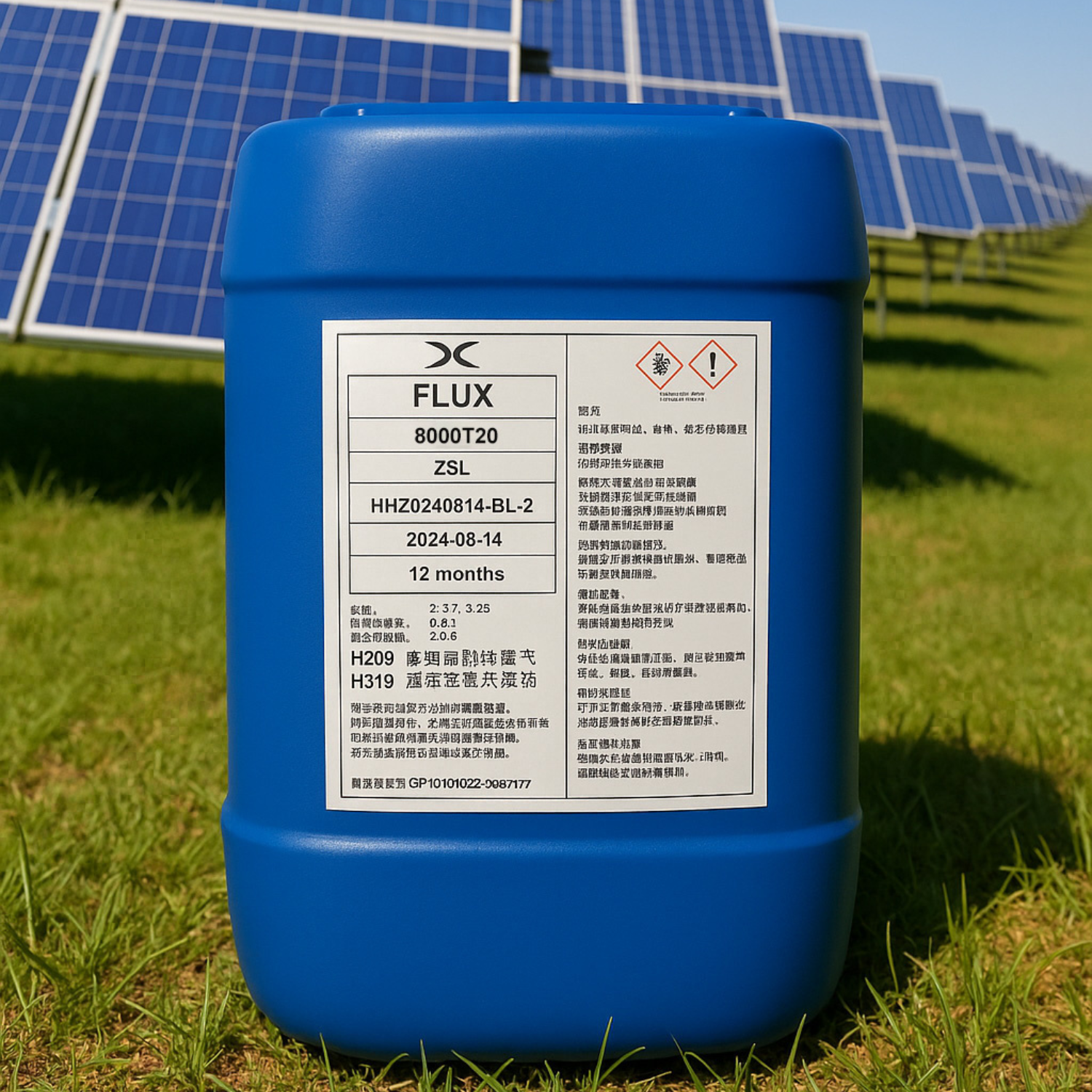
In the fast-evolving solar and electronics manufacturing sectors, flux formulations play a critical role in ensuring high-quality solder joints, high yields, and long-term reliability. Among advanced flux types, Flux 8000T20 (IMPROVED TYPE) emerges as a high-performance, environmentally friendly option tailored for photovoltaic module soldering. In this blog, we explain its key features, advantages, recommended usage, and best practices to help engineers, procurement teams, and factory operators make informed choices.
What Is Flux 8000T20 (IMPROVED TYPE)?
Flux 8000T20 is a specialized soldering flux designed specifically for photovoltaic (PV) module manufacturing. It belongs to the 8000T series of fluxes and is tailored for solar cell ribbon soldering processes.
Key characteristics include:
- Low halogen content — making it safer, more environmentally friendly, and compliant with many green manufacturing requirements.
- Low solid content — which helps reduce residue and avoids clogging or bridging issues.
- High insulation resistance (high impedance) — ensuring that residual flux does not degrade electrical separation or cause leakage currents.
- Non-corrosive residue with EVA / polysilicon substrate compatibility — essential so that the flux does not damage encapsulants or module layers.
- Stable activity at high temperatures — critical for soldering in elevated-heat PV ribbon lines.
Because of these combined traits, Flux 8000T20 (IMPROVED TYPE) is considered a no-wash or low-wash flux suitable for high-throughput PV assembly.
Why Choose Flux 8000T20?
Here are the major advantages that make it a preferred choice in industrial solar module assembly:
- Cleaner Residue & Reliability: Low solids and low halogen minimize sticky or conductive residues. That translates to better module reliability, lower defect rates, and longer lifetimes.
- Compatibility with Photovoltaic Materials: Its non-corrosive nature is safe for use with EVA films, polysilicon wafers, and silver/aluminum ribbons—avoiding undercutting or delamination issues.
- High-Temperature Performance: It retains adequate reactivity during ribbon soldering even under harsh conditions (high belt temperature, fast throughput), ensuring good wetting and penetration.
- Environmental Compliance: Reduced halogen and low solid content positions it favorably under regulations (RoHS, WEEE, etc.), which many solar manufacturers must meet.
- Cost Efficiency: Because it is a no-wash or low-maintenance flux, it reduces the need for post-cleaning stages, saving water, chemicals, labor, and process time.
How to Use Flux 8000T20: Best Practices
To extract the best performance, follow these operational guidelines:
- Application Method: Use spray or foam application to deposit flux uniformly on the ribbon or cell interface. Adjust flow to maintain consistent coverage without over-application.
- Flux Dosage: Control solids deposition, e.g. 1,000–1,600 µg solids per in² (or equivalent metric) depending on single- or dual-wave soldering. (Note: this is analogous to rules seen in electronics flux practices)
- Preheating: Preheat the substrates to aid flux activation and evaporation of solvents, but avoid too steep a ramp that might cause bubbling or residue spread.
- Soldering & Contact Time: Maintain proper contact time (often 1.5–3 seconds) at the molten solder interface. Always optimize conveyor speed, belt angle, and thermal profile according to your line’s demands.
- Quality Control: Periodically test insulation resistance (SIR), copper mirror tests, and halide check to monitor flux effectiveness and residue quality—similar to practices in electronics flux qualification.
- Storage & Shelf Life: Store in sealed containers at moderate temperature. Keep away from moisture or direct heat to prevent degradation. Always follow manufacturer’s shelf-life guidelines.
Real-World Applications & Use Cases
Flux 8000T20 is ideal in:
- Tab-and-stringing lines for solar PV module interconnects
- Automated ribbon-soldering systems (single- or dual-wave)
- High-throughput mass production where cleaning stages are minimized
- Manufacturing contexts demanding environmental compliance and low defect yields
When deployed properly, it helps achieve yields above 99.9 %, lower rework rates, and stable module performance over decades.
Conclusion & Considerations
Flux 8000T20 stands out as an advanced flux solution tailored for the photovoltaic industry. Its low halogen, low solids, non-corrosive residue, and high insulation properties make it well suited for modern PV module assembly. However, actual performance depends heavily on process optimization—flux dosage, preheat profiles, thermal control, and quality validation.
At Sumitron, we can guide customers in selecting and integrating Flux 8000T20 into your production environment—ensuring alignment with global standards, process consistency, and long-term reliability. Contact us for technical support, supply, customization, and validation services.
View Also This Product