
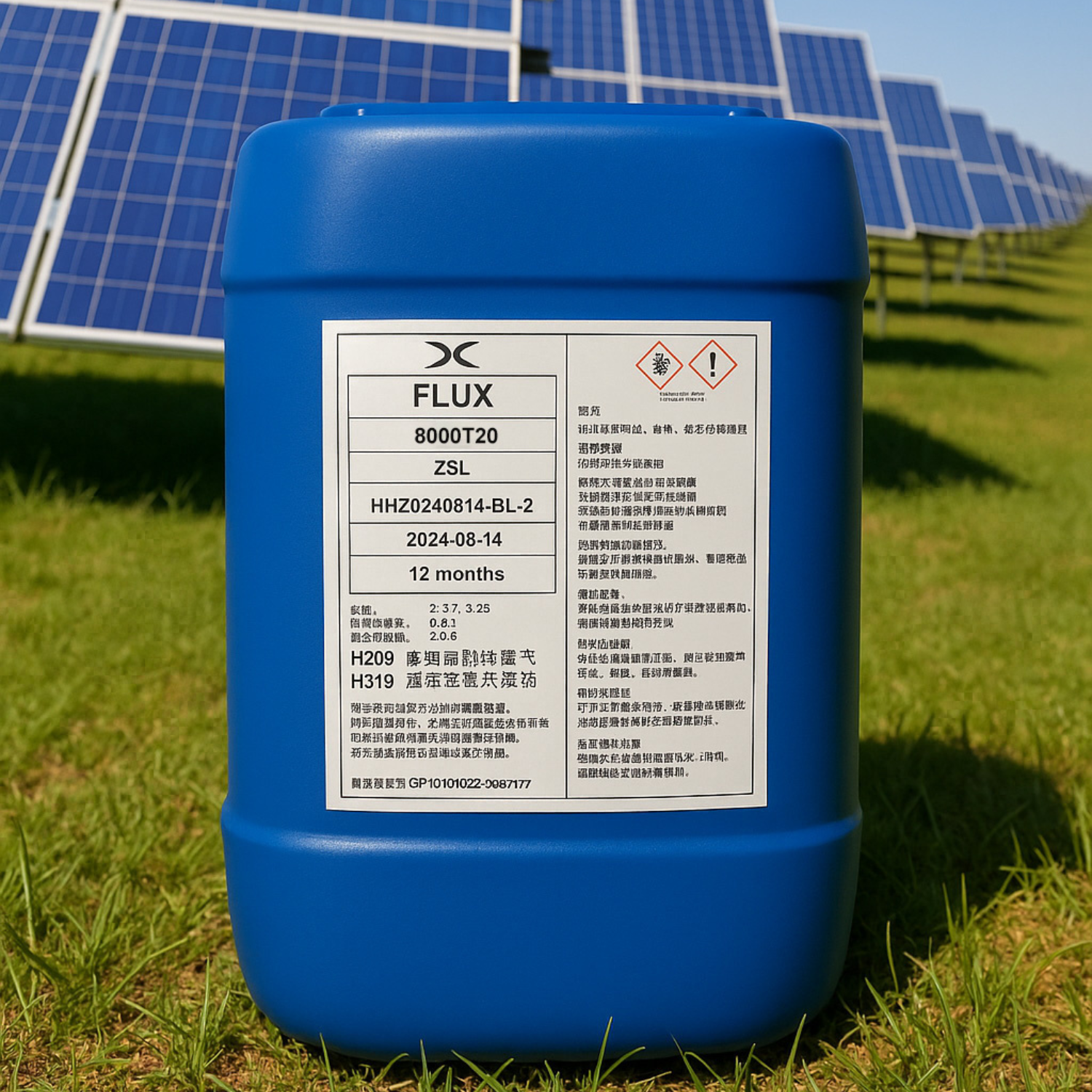
In photovoltaic (PV) module manufacturing, precision in soldering directly determines power output, reliability, and lifespan of solar panels. Yet, even the most advanced soldering lines encounter recurring defects such as voids, poor wetting, and residue bridging. These issues not only reduce module efficiency but can also increase rework, production delays, and long-term field failures.
Fortunately, advanced flux technologies like Flux 8000T20 for PV modules offer a robust solution to these recurring challenges.
Voids — Trapped Gas That Weakens Connections
Problem: Voids are small air pockets or gas inclusions trapped within solder joints. They create weak spots, reduce thermal conductivity, and lead to localized heating — a common cause of early module degradation.
Root Causes:
- Excessive flux residue or poor solvent evaporation before soldering
- Inconsistent temperature profile or too rapid preheat
- Contaminated or oxidized surfaces on ribbons or busbars
How Flux 8000T20 Helps: This improved-type flux features optimized solvent volatility and controlled solid content, allowing even evaporation during preheat. It ensures stable wetting without trapping gases, resulting in dense, void-free solder joints essential for long-term module durability.
Poor Wetting — Incomplete Solder Spread on Cell or Ribbon
Problem: Poor wetting occurs when solder fails to uniformly spread over the metallic surface, causing incomplete bonds or weak adhesion between the ribbon and the cell’s busbar.
Root Causes:
- Oxidized copper or silver coating on the ribbon
- Insufficient flux activation at peak temperature
- Incompatible or degraded flux formulation
How Flux 8000T20 Helps: Engineered with high-activity rosin derivatives and low-halogen activators, Flux 8000T20 maintains strong surface tension control and oxide removal at elevated temperatures. This ensures smooth solder flow, excellent wetting, and consistent adhesion even in high-speed tabbing and stringing operations.
Residue Bridging — The Hidden Conductive Path
Problem: After soldering, residual flux can sometimes form conductive bridges, leading to potential short circuits, insulation failure, or poor encapsulation adhesion during EVA lamination.
Root Causes:
- High-solid flux composition leaving sticky residues
- Over-application of flux during automated spraying
- Improper thermal curing before lamination
How Flux 8000T20 Helps: The improved formulation of this flux contains ultra-low solid content and non-corrosive, non-conductive residues. It leaves minimal, dry, transparent films that do not affect the electrical insulation or adhesion properties. Thus, it supports cleaner surfaces and zero post-cleaning requirements, ideal for no-wash PV production lines.
Process Control Checklist for PV Line Operators
To fully benefit from Flux 8000T20, consistent process discipline is essential. Below is a quick checklist to maintain top-quality soldering results:
| Parameter | Recommended Practice |
|---|---|
| Flux Application | Use spray or foam coating for uniform, thin coverage. Avoid puddling. |
| Preheating | Allow gradual solvent evaporation; surface temp ≈ 100–120 °C before solder contact. |
| Solder Temperature | Maintain 250–260 °C ribbon solder bath or tip temp, depending on alloy. |
| Flux Dosage | Adjust to keep solid deposition between 1,000–1,600 µg/in². |
| Residue Inspection | After soldering, ensure clear and non-sticky joints before lamination. |
| Storage | Keep flux containers sealed at 10–30 °C to maintain stability. |
Following these guidelines not only reduces rework rates but also ensures that every module leaving your production line meets IEC reliability standards.
Final Thoughts
Soldering defects in solar manufacturing often trace back to overlooked details — uneven flux application, poor thermal balance, or outdated chemistry. By switching to a next-generation formulation like Flux 8000T20, manufacturers can significantly enhance bond integrity, eliminate voids, and maintain cleaner module interfaces. The result is higher yield, better field reliability, and sustainable production efficiency — exactly what modern PV lines demand.
For more information, technical data sheets, or on-site process support, contact Sumitron’s technical team — your global partner in advanced flux and soldering solutions.
View Also This Product